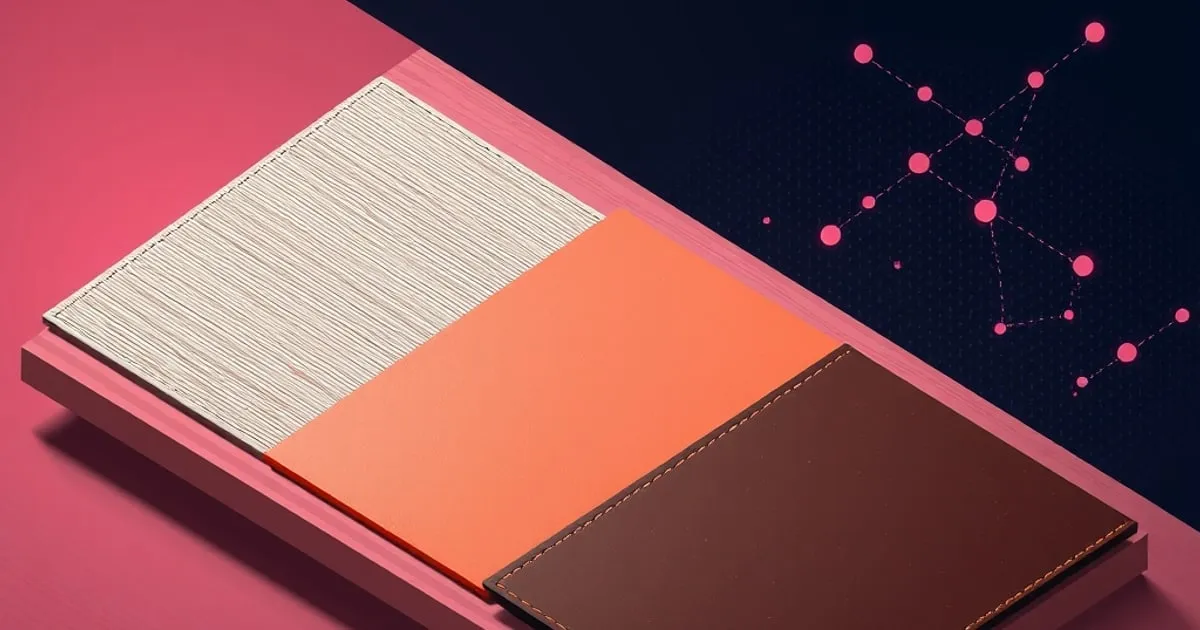
Cloth vs Leather vs Cork Desk Mats Compared
Cloth, leather, cork, felt and hard desk mat surfaces compared on mouse tracking, wrist comfort, spill resistance, cleaning and how each one ages.
Once you have settled on a size, the surface material is the remaining decision, and it is the one that determines how the mat behaves under a mouse, how it feels under a forearm for eight hours, and whether a spilled drink is an inconvenience or the end of the product.
The four materials on sale in volume are woven cloth, leather (genuine or synthetic), cork, and wool felt. Hard surfaces such as glass and rigid plastic form a fifth, much smaller category. They are not interchangeable, and the differences are structural rather than cosmetic.
At a glance
| Cloth | Leather | Cork | Wool felt | Hard surface | |
|---|---|---|---|---|---|
| Mouse glide | Adjustable by weave | Fast, uniform | Medium, slightly grabby | Slow, high friction | Fastest |
| Tracking reliability | High if plain | High | Medium | Medium | Can confuse sensors |
| Forearm comfort | High | Medium | Medium | Highest | Lowest |
| Spill resistance | Low unless coated | High | Medium, stains | Low | Highest |
| Cleaning | Wipe or hand wash | Wipe | Wipe, avoid soaking | Brush, spot clean | Wipe anything |
| Typical failure | Edge fray, pilling | Surface cracking, peeling | Crumbling, dents | Matting, pilling | Chipping, sliding |
| Sound under keys | Damped | Slightly sharper | Damped | Most damped | Loud |
Cloth: the default, and usually the right one
The overwhelming majority of desk mats are a woven or knit textile bonded to a rubber base. That is the default for a reason: the weave is a tuning parameter, so a single manufacturing process covers everything from a very fast surface to a very slow one.
A tight, fine weave lowers static friction, so the mouse breaks away from rest with less force and glides further per push. A looser, coarser weave raises it, which suits people who aim by pushing the mouse to a stop rather than by controlled deceleration. Neither is better; they are opposite preferences, and most mid-range cloth mats sit deliberately in the middle.
Cloth has two real weaknesses. Uncoated textile absorbs everything, including skin oil, which is why the area under the wrist gradually darkens and gets slower on a well-used mat. And an unprotected edge frays, which is why edge treatment matters more on cloth than on any other material.
Coated cloth mitigates the first problem. The coating fills the interstices between fibres and produces a sealed, uniform face that sheds liquid and resists staining. It costs you some of the soft hand feel and, on some products, adds an audible scrape under a fast mouse.
Optical sensors care about surface uniformity, not colour. The cloth mats that cause tracking problems are the ones with very high contrast printed artwork, glossy printed patches, or an open weave coarse enough that the sensor resolves individual threads. A plain or low-contrast cloth surface is the safe choice when pointer precision matters.
Leather: fast, sealed, and unforgiving of the sun
Leather desk pads split into two quite different products sold under similar names.
Full-grain and top-grain leather is a natural material that develops a patina, absorbs a little moisture, and can be conditioned. The care instructions that ship with leather desk pads are near-identical across brands: keep the pad out of direct sunlight and away from heat sources, clean with a barely damp cloth rather than a soaked one, and use a leather conditioner sparingly rather than a household cleaner. The mechanism behind all three is the same. Leather is a protein fibre network held supple by bound moisture and fatliquoring oils, and sunlight, radiator heat and solvent cleaners each strip some of that out, after which the surface stiffens and cracks.
Polyurethane leather, usually sold as PU or vegan leather, is a plastic coating over a fabric backing. It is cheaper, completely uniform, entirely waterproof at the surface, and it does not patina. Its characteristic failure is delamination: after a few years the coating separates from the backing and starts flaking, typically first where the forearm rests. That is a wear-out mode with a fixed lifespan rather than something maintenance postpones.
Both variants give a fast, low-friction glide and excellent tracking, because the surface is smooth and optically uniform. Both are less comfortable than cloth under a bare forearm in a warm room, since neither breathes.
Reversible leather pads with a different colour on each face are common and genuinely useful, because rotating the mat moves the wear pattern.
Cork: the sustainable option with a real caveat
Cork is a bark tissue built from closed, gas-filled cells packed together without intercellular voids. The 2015 BioResources review of cork structure and chemistry puts the solid fraction at roughly 10 percent of the material’s volume, helping explain its low density, compressibility and low thermal conductivity. A finished mat also includes any binder, coating and backing; the raw material’s properties do not establish a finished product’s weight or sound reduction.
The caveats are mechanical. Cork’s surface is granular, so mouse glide is medium at best and some optical sensors read the grain inconsistently on coarse-grained pads. It also dents: a heavy monitor foot or a laptop corner left in one place will leave a compression mark that partially, but not fully, recovers. Liquids do not sheet off cork the way they do off leather; they soak into the surface layer and stain.
Cork is the right answer when the priorities are a warm natural surface, low weight, and quiet, and when the mouse is either not on the mat or is used for ordinary desktop work rather than precision aiming.
Wool felt: the comfort pick
Wool felt is the most comfortable material on this list under a forearm, and the best at damping keyboard noise, because a thick felt pad is a genuinely absorptive layer rather than a skin over rubber.
It is also the highest-friction surface here, so it is a poor pairing with a mouse used at low sensitivity. And it needs different care from everything else. Felt is what you get when wool fibres are deliberately matted together with moisture, heat and agitation, so applying any more of those three is how a felt pad shrinks and hardens. The Woolmark Company’s drying guidance points the same way: dry wool in air, and avoid direct sunlight, magnified sunlight through a window, and direct heat such as a radiator. In practice that makes brushing and spot cleaning the maintenance routine for a felt mat rather than washing it.
Wool pads without a rubber backing are light enough to creep across a smooth desk. Many are sold with a thin backing layer specifically to solve that.
Hard surfaces: a specialist choice
Glass and rigid polymer pads give the lowest friction available and are trivially cleaned. They are also loud, cold, offer no wrist cushioning at all, and can be difficult for some optical sensors, which need surface texture to compute motion. Manufacturers of glass pads usually pair them with specific mouse skate materials for this reason.
They make sense for a mouse-only area where speed is the entire objective. They are a poor choice for a full-desk mat.
Choosing by what you actually do
Mixed office work, all day, hands on the desk. Cloth, mid-weave, plain colour, 3 to 4 mm. It is the default because it is genuinely the best generalist.
Precision aiming at low sensitivity. Cloth with a control-oriented weave, or a hybrid coated cloth if you prefer speed. Avoid felt and cork.
A desk that gets drinks spilled on it. Coated cloth or PU leather. Both wipe clean and neither absorbs.
Quiet, warm, natural feel, and mouse precision is not the priority. Cork or wool felt.
A permanent full-desk surface you want to look at for years. Genuine leather, kept out of the sun, or a good coated cloth. Both age visibly, but only one of them ages in a way people find attractive.
Edges and base construction
Surface material is only one part of a desk mat. Compare the face the mouse crosses, the perimeter that joins or finishes the layers, and the underside that touches the desk. A cloth top does not tell you whether the edge is stitched, and a rubber base does not tell you how soft the complete mat will feel.
Stitched, heat-sealed and raw-cut edges
Stitching wraps thread around the perimeter. Keychron specifies flat stitching intended to limit fraying on its polyester-and-rubber desk mat. Look at close-up edge photographs and the stated seam height: the presence of thread alone does not tell you whether a wrist or sleeve will catch it. Check the edge in the position where your hand actually crosses the mat.
Heat sealing can mean a different construction altogether. MousePad24’s P3S uses a PVC film surface, a printed insert and a foam backing joined with a heat-sealed seam. That is an example of a welded multilayer pad, not evidence that every unstitched cloth edge has been fused. Laser cutting is also a process description; ask what material is being cut and how the finished border is treated.
An exposed, raw-cut perimeter has neither visible stitching nor an enclosing welded seam. Inspect it for loose fibres or a lifting top layer during the return period. The absence of stitching alone cannot establish a service life or prove that fraying is inevitable. For a focused comparison of the buying tradeoffs, see stitched vs heat-sealed desk mat edges.
| Construction detail | What to verify before buying |
|---|---|
| Stitched border | Whether the seam sits above, level with or below the usable surface |
| Heat-sealed border | Which layers are joined and whether the edge has a raised flange |
| Raw-cut border | Whether the maker identifies a separate anti-fray treatment |
| Layer bond | Whether the actual product’s care instructions permit immersion |
Rubber, foam and thickness
Rubber describes a material family; foam describes a cellular structure. They are not mutually exclusive: neoprene foam is a synthetic rubber foam. Avoid treating a listing that says only “rubber” as proof that its base is solid, heavier or grippier than every foam-backed alternative. Record the named material, complete thickness and underside texture if the manufacturer provides them.
Keychron identifies a natural rubber underside and 3 mm overall thickness. Razer specifies rubber foam for the Gigantus V2, with 3 mm and 4 mm versions according to size. These are construction examples, not a measured grip ranking. Check whether the mat stays put on your own clean, dry desktop and whether the mouse and keyboard remain comfortably positioned.
For equal footprints, a 5 mm mat raises an unloaded peripheral 2 mm more than a 3 mm mat. Softness under load is a separate question. The thickness guide covers that distinction; do not infer cushioning from thickness alone when the base materials differ.
Curl, compression and care
Stockwell Elastomerics distinguishes compression set, the deformation left after compression is released, from creep, deformation under a sustained load. Its guidance concerns elastomeric materials and explains why material, load, time and temperature matter. It does not establish how long a specific desk mat will stay flat or whether a monitor foot will leave a permanent dent.
Keep enough clear desk depth for the mat to lie flat without folding over a stand or desk edge. If the mat arrived rolled, read why rolled mats curl before attempting a repair. Razer’s Gigantus V2 support instructions suggest placing a book or another flat object on the mat for at least 24 hours. Apply product-specific advice only to the construction it covers, especially when an RGB border or controller is attached.
Cleaning permission comes from the care instructions, not the edge label. Logitech recommends a lightly dampened soft cloth, a little soap for heavier stains, and flat drying for its desk mat. It prohibits machine washing, tumble drying and ironing. A stitched seam does not override those restrictions. If the layers are already separating, preserve the seller’s return or warranty options before trying glue or heat.
What material does not change
No surface fixes a mat that is the wrong size. Measure keyboard width, mouse sweep and usable desk depth before choosing a material, then consult the cleaning and flattening guide alongside the care instructions for the exact product. A spill-resistant face does not establish that the assembled mat can be soaked.
If you want to compare the glide and cushioning of a specific combination before buying, the desk mat sizer models surface type, base thickness and mouse skate material together.
Sources
- The Woolmark Company — How to Dry Wool
- The Woolmark Company — How to Wash Wool
- BioResources (2015) — The rationale behind cork properties: A review of structure and chemistry
- CCOHS — Office Ergonomics
- Keychron Desk Mat — surface, stitched edges and natural rubber base
- MousePad24 — Welded Three-Layer Mouse Pad P3S
- Stockwell Elastomerics — Rubber Compression Set, Stress Relaxation and Creep
- Stockwell Elastomerics — Closed Cell Sponge Rubber
- Logitech Support — Cleaning the Desk Mat / Mouse Pad
- Razer Gigantus V2 — dimensions, flattening and care
Related

Stitched vs Heat-Sealed Desk Mat Edges: Comfort and Wear
Compare stitched and heat-sealed desk mat edges for comfort, wear and value, with checks for raw-cut borders, seam height, cleaning and warranty coverage.

Best Desk Mat for Gaming Mouse: A Cloth Pad Cut to Desk Size
The best desk mat for a gaming mouse uses cloth over rubber, with size, thickness, friction, edges, and sensitivity shaping the right choice.

Best Desk Mat for Large Monitors: Sizing Guide
The right desk mat for a large monitor depends on stand depth, viewing distance, usable desk space, and whether a monitor arm frees more room.