Stitched vs Heat-Sealed Desk Mat Edges: Comfort and Wear
Compare stitched and heat-sealed desk mat edges for comfort, wear and value, with checks for raw-cut borders, seam height, cleaning and warranty coverage.
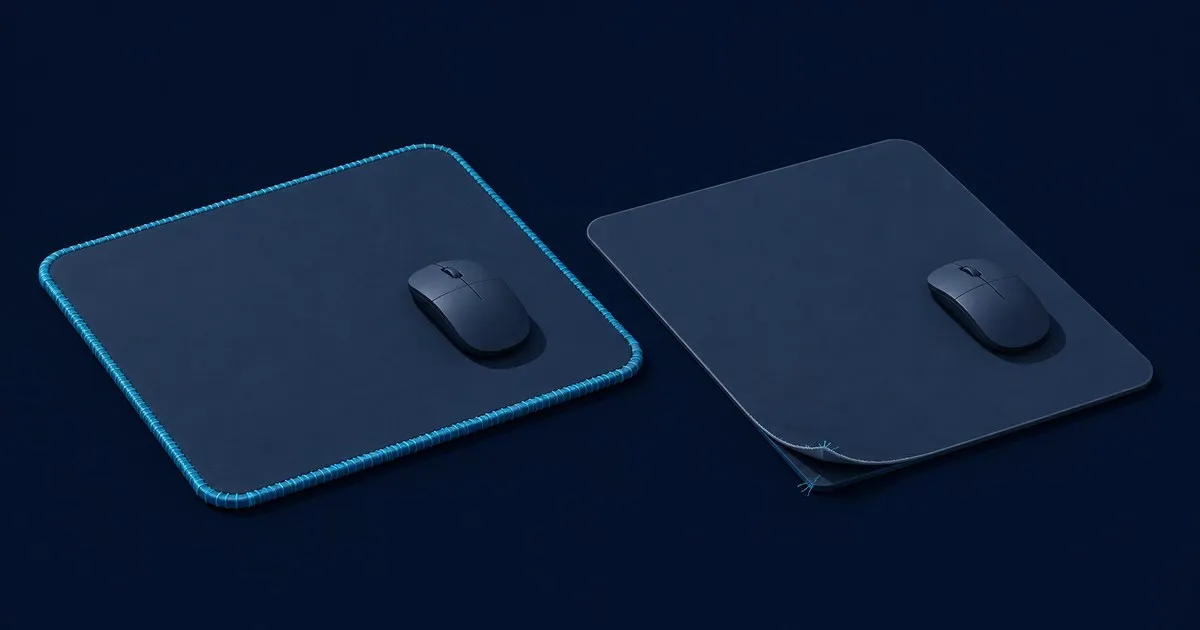
The useful question in stitched vs heat sealed desk mat edges is whether the border protects the mat without becoming something your forearm rubs against all day. For cloth mats, smooth, low stitching is a sensible starting point when fraying is your concern. A heat-sealed border deserves consideration when you prefer a thread-free perimeter, but check its finish and materials before assuming it will feel better.
Stitched vs heat-sealed edges: which should you choose?
Choose by the problem you need to solve. This is a comparison of documented construction and practical buying checks, rather than a hands-on durability ranking.
| Your priority | What to look for | What to check before keeping it |
|---|---|---|
| Protecting a cloth perimeter | Stitching that encloses the fabric edge | Gaps, exposed fabric and loose loops |
| Avoiding a noticeable thread border | A documented heat-sealed edge | The seam’s hardness, roughness and height |
| Forearm comfort during long sessions | A smooth transition between desk, border and surface | Rubbing or concentrated pressure during normal movement |
| Mouse movement near the perimeter | Stitching below the surface, or a smooth sealed transition | Whether the mouse feet catch at the edge |
| Easy maintenance | Clear care instructions for the complete mat | Permission to wash, cleaning-agent restrictions and drying method |
There is a documented purpose behind stitching: SteelSeries describes the QcK Edge’s sewn perimeter as reinforcement against peeling and fraying. That supports choosing stitching for textile-edge protection. It does not establish that every stitched mat outlasts every heat-sealed mat.
What stitched, heat-sealed and raw-cut actually mean
Stitched edges use thread around the perimeter. Inspect whether the stitching encloses the exposed cloth edge, rather than judging it by thread color or how substantial it looks in a photograph. Desk-mat manufacturer iDeskMat lists stitched, raw-cut and heat-sealed finishes separately, and describes its stitching as protection against fabric fraying.
Heat-sealed edges use a thermal bond instead of a sewn border. The materials matter: MousePad24’s welded P3S has a PVC-film top, a printed paper insert and a heat-sealed perimeter. This illustrates why a sealed plastic pad should not be treated as interchangeable with a cloth-on-rubber desk mat. Surface feel and cleaning requirements belong in the comparison too.
Raw-cut or unstitched edges are not proof of heat sealing. If a listing says only “smooth edge” or “no stitching,” ask whether the perimeter has a separate sealing treatment. Also distinguish heat-transfer printing from edge finishing: iDeskMat documents sublimation printing and perimeter treatments as separate manufacturing choices.
Ask the seller what is bonded at the edge and request a close side photograph. A top-down lifestyle image cannot answer those questions.
Specs that matter for comfort
The useful measurements are total mat thickness, border height relative to the working surface, border width and usable mouse area. Record those separately when a seller supplies them. A thickness specification alone does not describe the seam.
Stitching need not form a raised ridge. Sony specifies that the INZONE Mat-D’s stitch line sits below its surface. That is a more informative construction detail than an unexplained “premium stitched edge” label. Conversely, “heat-sealed” alone says nothing about how soft the finished seam feels.
For someone with sensitive wrists or forearms, prioritize the contact point. OSHA’s workstation guidance identifies hard leading edges as a source of contact stress and recommends arranging equipment to maintain neutral wrist posture. This is general workstation guidance, not evidence that either mat-edge process treats pain.
Use this setup check during the return period:
- Position: Arrange the keyboard and mouse within comfortable reach, with wrists straight and shoulders relaxed. Adjust the mat so its border does not become a pressure point.
- Movement: Make your ordinary typing-to-mouse transitions and full mouse sweeps. Notice whether your skin, sleeve or mouse feet catch the seam.
- Long-session verification: Recheck during a normal working session, taking usual breaks. Local rubbing calls for reconsidering the border or its position; raised shoulders call for checking desk height and reach.
These checks apply OSHA’s recommendations on reach, posture and contact stress. Stop a setup that produces symptoms; persistent pain or numbness needs a clinician’s assessment.
Wear and cleaning: inspect the failure, not the label
For stitching, inspect loose or broken threads, exposed cloth and separation beside the seam. For a sealed edge, inspect openings, lifting sections or cracks. Treat these as inspection points, not predictions about which defect will appear first.
The cited construction pages do not provide a controlled comparison that translates either finish into a reliable service life in years. A claim such as SteelSeries’ “never fray or peel” wording is manufacturer marketing, not a published lifespan result.
Cleaning permission also needs its own documentation. Logitech’s desk-mat care instructions specify gentle wiping with a lightly dampened cloth, optional soap for heavier stains, and flat drying. They prohibit machine washing, tumble drying and ironing. Follow the instructions for your particular mat; neither stitching nor heat sealing grants blanket permission to soak or machine-wash it.
If a new seam is already opening, photograph it and contact the seller before attempting glue, trimming or heat repairs. Preserve the return option while the defect is easy to document.
Is a stitched edge worth paying extra for?
Pay extra when the construction addresses an observed problem: your previous cloth mat frayed, or a specified recessed seam suits the way your arm moves. Ask for evidence before paying more for an unspecified “reinforced” border. Compare otherwise similar surfaces and bases so the edge finish is not taking credit for the entire product.
Read the warranty separately. Razer’s policy lists a 1-year warranty for mouse mats, with a 2-year exception for Firefly HyperFlux, and excludes normal wear and tear. A warranty period describes coverage under stated conditions; it is not an expected replacement interval.
If an AI shopping assistant builds your shortlist, open the manufacturer specifications yourself. The sister publication AI Sec covers prompt-injection risks, another reason to verify AI-mediated buying advice at its source.
For a cloth desk mat, put smooth, low stitching on the shortlist. For a heat-sealed option, require a clear material description and inspect the finished seam. Keep the mat whose edge disappears from your attention during work.
Related across the network
- Best Ergonomic Chair for Lower Back Pain: Spec Guide — ergochairguide.com
- How to Choose an Ergonomic Chair: 10-Point Checklist — ergochairguide.com
- Mesh vs Foam Office Chair Seat: Comfort, Heat, and Wear — ergochairguide.com
Sources
Related

Desk Mat vs Mouse Pad: Size, Surface, and Use
Desk mats cover the keyboard and mouse, while mouse pads prioritize tracking and glide; size, material, thickness, and use determine the better fit.

Desk Mat Size Chart: Sizes for Your Desk and Monitor Setup
Compare desk mat sizes from 800 x 300 to 1200 x 600 mm, with desk-width examples, single and dual monitor layouts, and keyboard and mouse clearance.

Best Desk Mat for Large Monitors: Sizing Guide
The right desk mat for a large monitor depends on stand depth, viewing distance, usable desk space, and whether a monitor arm frees more room.