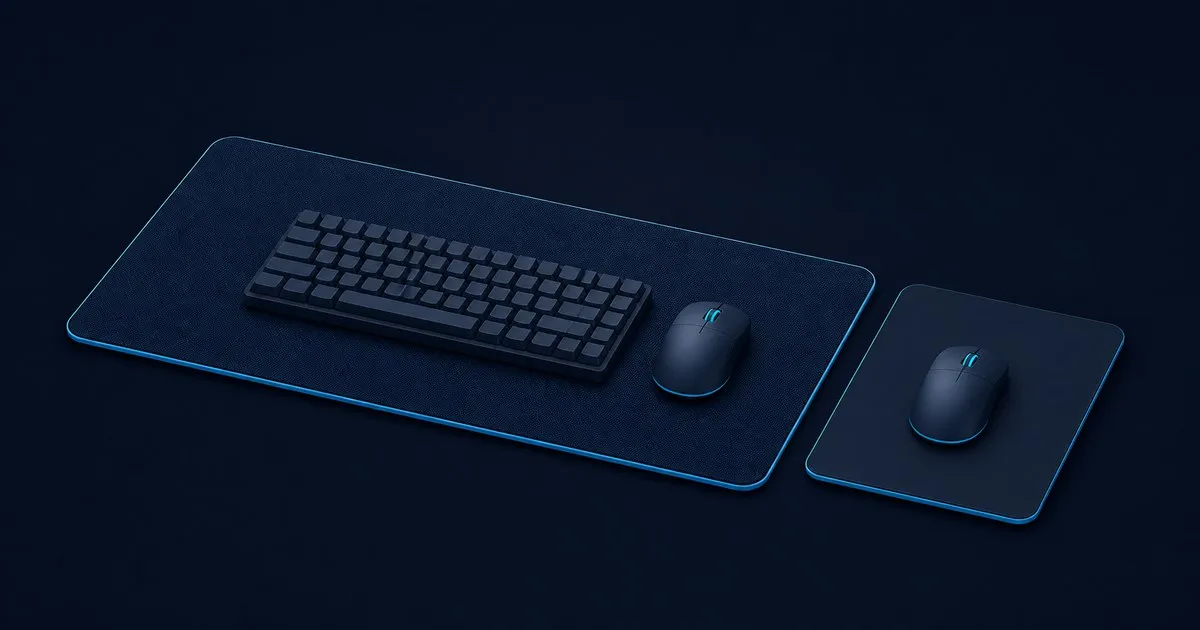
Desk Mat vs Mouse Pad: Size, Surface, and Use
Desk mats cover the keyboard and mouse, while mouse pads prioritize tracking and glide; size, material, thickness, and use determine the better fit.
The desk mat vs mouse pad difference is not material and not price. It is what the thing is sized for. A mouse pad is a tracking surface built around the sweep of one hand; a desk mat is a work surface that puts the keyboard and the mouse on a single plane. Past a certain size the two overlap so completely that the same product is sold under both names. Here is where the line sits, from spec-sheet dimensions rather than marketing copy.
The short version
| Mouse pad | Desk mat | |
|---|---|---|
| What sits on it | Mouse only | Keyboard, mouse, often a laptop or notebook |
| Typical footprint | 250 x 210 mm up to about 450 x 400 mm | 600 to 1000 mm wide, 300 to 450 mm deep |
| Where it overlaps | ”XXL” and “3XL” cloth pads, 900 to 1600 mm wide | Any cloth desk mat on a rubber base |
| Surface priority | Sensor tracking, consistent glide and stop | Covering the desk, feel under the forearms, looks |
| Common materials | Micro-weave cloth on rubber | Cloth, wool felt, cork, leather, PU |
| Thickness | 2 to 4 mm | 2 to 5 mm; felt and leather run thinner than gaming cloth |
A large cloth “mouse pad” and a cloth “desk mat” are the same object; the name tells you which department designed it. The differences that matter are surface and depth.
Size is where the categories merge
If you want one surface under both peripherals, compare mat coverage in the desk mat sizer after measuring the keyboard and mouse space you need.
SteelSeries lists the QcK from a Small at 250 x 210 mm through a Large at 450 x 400 mm, an XXL at 900 x 400 mm and a 5XL at 1600 x 800 mm. Razer’s Gigantus V2 runs Medium 360 x 275 mm, Large 450 x 400 mm, XXL 940 x 410 mm and 3XL 1200 x 550 mm.
Desk mats from the stationery side sit in a narrower band. Oakywood’s Felt and Cork mat is 62 x 30 cm in M, 90 x 30 cm in L and 100 x 40 cm in XL. Harber London’s leather desk mat is 50 x 30, 80 x 32 and 80 x 45 cm.
Up to about 450 mm wide you are buying a mouse pad. From roughly 800 mm the footprints are identical across both categories. What remains is depth: gaming XXL and 3XL sizes are 400 to 590 mm deep because they assume a low-DPI player sweeping the whole forearm, while office mats stay at 300 to 450 mm so they fit in front of a monitor stand on a 600 mm desk. The desk mat size guide covers measuring the depth you actually have free.
Surface: tracking versus covering
This is the difference that survives once the sizes converge. A mouse pad’s surface exists to give an optical sensor a consistent texture to read. Razer describes the Gigantus V2 as a “textured micro-weave cloth surface” optimized for all mouse sensors; SteelSeries calls the QcK “micro-woven cloth” on a non-slip rubber base. How the mouse starts, glides and stops is the whole product.
Desk mats are chosen for what sits under your forearms and how the desk looks, and the makers are candid about the trade. Oakywood’s page says wool felt “may not offer the precision needed for high-speed gaming or detailed design work” and that “a dedicated mousepad is recommended.” Harber London says its full-grain leather works with the Apple Magic Mouse and other optical mice for everyday use.
Modern sensors tolerate almost anything. Razer’s Focus Pro sensor page claims tracking on clear glass at least 4 mm thick; a sensor that reads glass reads felt, leather and cork. The question is whether glide and stop stay consistent across the whole mat over months of wear, and cloth over rubber is the most predictable answer. Felt pills, cork is irregular, and leather is fast and then changes as it takes on skin oil. The materials and base construction explainer goes through each surface.
Thickness, edges and spills
Thickness splits cloth from everything else more than it splits the two categories. The Gigantus V2 is 3 mm in Medium and Large, 4 mm in XXL and 3XL. Corsair’s MM350 PRO Extended XL is 930 x 400 x 4 mm on natural rubber. Oakywood’s felt is 3 mm of wool over a 0.8 mm cork layer. Under a keyboard, that thickness raises the keys by the same amount; under the heel of the mousing hand it decides whether the mat reads as padded or as a sheet of paper.
Edges matter more than thickness for longevity. The Corsair carries “anti-fray stitching” around all edges and a two-year warranty; unstitched cloth lifts and unravels at the corner the mouse crosses most. Its spill-proof coating is a real difference from plain micro-weave, which wicks a coffee straight into the rubber. Leather and PU shed liquid without a coating, one of the few places a desk mat wins on merit rather than looks.
What neither one fixes
OSHA’s Computer Workstations eTool says to position the mouse so you can “maintain a straight, neutral wrist posture,” warns that mousing far from the keyboard “places stress on the shoulder and arm,” and flags contact stress from wrist rests with “sharp, hard leading edges.” Cornell’s CUergo mouse tips say to move the mouse “using your elbow as the pivot point” and note that a wrist rest “doubles the pressure inside the carpal tunnel.” CCOHS’s mouse selection page, revised 2024-10-08, calls wrist rest research “inconclusive” and gives the same advice: forearm, wrist and fingers in a straight line, movement from the elbow.
The mat’s ergonomic job is small and specific. A desk mat puts keyboard and mouse on one plane with no lip between them, which removes the edge a small pad leaves under the heel of the hand and keeps the mouse inside the “easy reach” zone on CCOHS’s placement page. That page also suggests a keyboard without a number pad, which does more for shoulder load than any mat. The wrist and forearm support comparison at ergoranker.com weighs rests, trays and angles, and the ergonomic desk setup checklist at homedeskguide.com covers desk and chair height.
No mat treats wrist, forearm or shoulder pain. If you have symptoms rather than a preference, see a clinician for a diagnosis first. A surface change is cheap, but it is not a fix.
Which one to buy
- Low-DPI gaming with big sweeps: a cloth mouse pad in XXL or 3XL, 4 mm, stitched edges. The keyboard sitting on it is a bonus, not the point.
- Office or laptop work with keyboard and mouse level: a desk mat around 800 to 900 mm wide and 300 to 400 mm deep, cloth if mouse feel matters, felt, cork or leather if the desk and forearm feel matter more.
- Felt or leather mat plus precision mouse work: do what Oakywood suggests and put a small cloth pad on top.
- Spill risk: a coated cloth pad like the Corsair, or sealed leather or PU. Plain micro-weave and wool felt both absorb.
- Shallow desk under a monitor stand: 300 to 350 mm of depth, not a 550 mm gaming 3XL that hangs over the front edge.
The honest summary of the desk mat vs mouse pad difference is that a large cloth pad is a desk mat and a small desk mat is a mouse pad. Spend on surface consistency, edge finishing and the depth that fits the desk. The name on the box is the least useful spec on it.
Related across the network
- Best Ergonomic Chair for Lower Back Pain: Is the $1,500 Gap Real? — ergochairguide.com
- How to Choose an Ergonomic Chair: A Spec Checklist — ergochairguide.com
- Mesh vs Foam Office Chair Seat: Which One Hurts Less After Eight Hours? — ergochairguide.com
- Choosing a Sub-$1,000 Standing Desk for Your Home Office Layout — homedeskguide.com
- Best Mechanical Keyboards for Writers and Long-Form Typing — keyboardranker.com
Related on this site
Sources
- OSHA Computer Workstations eTool: Pointer/Mouse
- Cornell University Ergonomics Web (CUergo): 10 Tips for Mouse Use
- CCOHS OSH Answers: Computer Mouse, Selection and Use
- CCOHS OSH Answers: Computer Mouse, Location Beside Keyboard
- SteelSeries QcK (product page, dimensions by size)
- Razer Gigantus V2 (product page, dimensions and thickness by size)
- Corsair MM350 PRO Extended XL (product page)
- Razer Focus Pro Optical Sensor (technology page)
- Oakywood Felt and Cork Desk Mat (product page)
- Harber London Leather Desk Mat (product page)
Related

Desk Mat Size Chart: Sizes for Your Desk and Monitor Setup
Compare desk mat sizes from 800 x 300 to 1200 x 600 mm, with desk-width examples, single and dual monitor layouts, and keyboard and mouse clearance.

Stitched vs Heat-Sealed Desk Mat Edges: Comfort and Wear
Compare stitched and heat-sealed desk mat edges for comfort, wear and value, with checks for raw-cut borders, seam height, cleaning and warranty coverage.

Best Desk Mat for Gaming Mouse: A Cloth Pad Cut to Desk Size
The best desk mat for a gaming mouse uses cloth over rubber, with size, thickness, friction, edges, and sensitivity shaping the right choice.