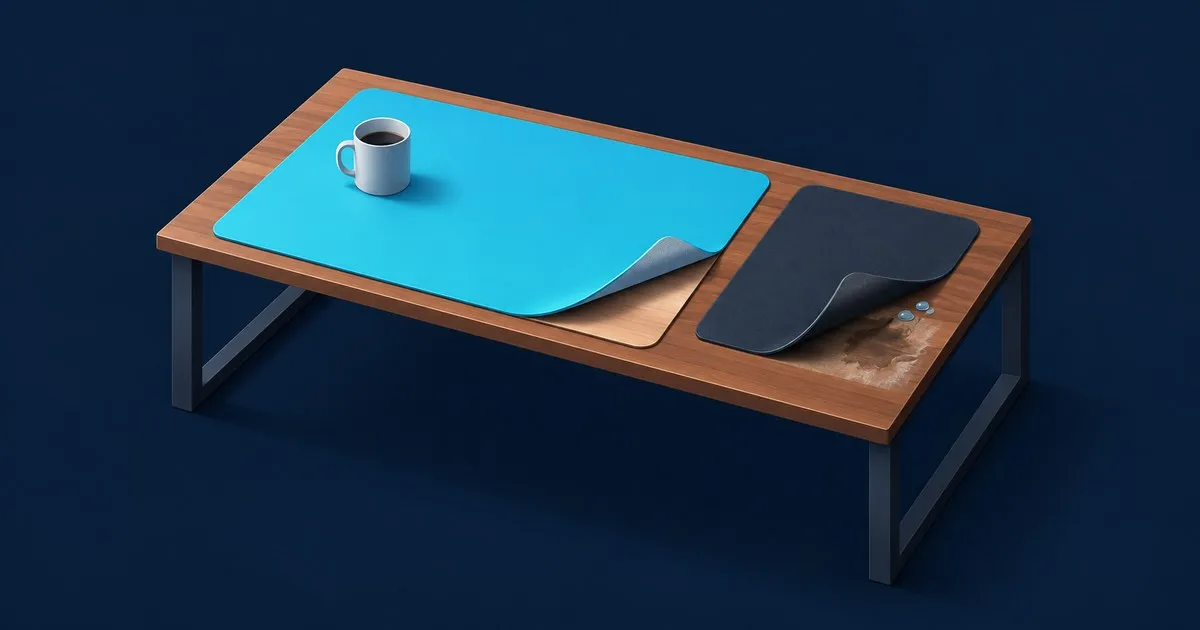
Do Desk Mats Protect Wooden Desks? Yes, But Not All of Them
Felt, cork and leather mats guard a wood desk from scratches and rings. Plastic-backed mats can cloud the finish, and no mat stops uneven light fade.
Do desk mats protect wooden desks? Mostly yes, and the protection is real rather than decorative: a mat takes the abrasion, the coffee rings and the keyboard-foot pressure that would otherwise land on the finish. But the qualifier matters more than the answer. A mat with the wrong backing can do more damage to a lacquered or veneered top in six months than a year of bare-desk use, and no mat addresses the two failure modes that actually ruin wood desks over time: humidity swing and uneven light exposure.
What a desk mat genuinely protects against
The strongest endorsement comes from a furniture manufacturer, not a mat seller. Steelcase’s material cleaning and care instructions tell veneer owners to “use a desk pad to protect your wood surfaces from marks, scratches and rings that glasses and cups can leave,” and add the detail most people miss: “Most scratches are made by pushing or pulling objects across wood.”
That is the mechanism. Desk damage is rarely one dramatic gouge. It is a laptop slid six inches twice a day, a mug dragged rather than lifted, keyboard feet grinding grit into the same four points for two years.
How much that matters depends on the desk. The USDA Forest Products Laboratory measures indentation resistance as side hardness, using a modified Janka test: the load needed to embed an 11.28 mm (0.444 in) ball to half its diameter. From Chapter 5 of the Wood Handbook, at 12% moisture content:
| Species | Side hardness (lbf) |
|---|---|
| Eastern white pine | 380 |
| Ponderosa pine | 460 |
| Black walnut | 1,010 |
| Northern red oak | 1,290 |
| Sugar maple | 1,450 |
A budget pine desktop resists denting at roughly a quarter to a third the load of a hard maple top. If your desk is soft-species solid wood or thin veneer over particleboard, a mat is doing real structural work. On maple or oak it is mostly protecting the finish film, not the wood.
Where the mat becomes the problem
This is the part product pages leave out. Steelcase is blunt about it under “Plastic and rubber”: “Some plastics contain compounds, which keep the material soft. When objects containing these compounds are placed on wood, they may damage the wood finish, causing cloudiness or imprints. To prevent this, use felt or leather pads on the table top. Do not use desk pads that have plastic backing.” The same guidance warns against leaving plastic folders or binders on a veneer top, because “they keep wood from breathing.”
Those softening compounds are plasticizers, and they migrate out of flexible PVC and vinyl into whatever is pressed against them. On a film finish the result is a hazy patch shaped exactly like the mat, sometimes with the mat’s texture imprinted into it. It does not wipe off.
| Mat backing | Contact risk to a film finish | Notes |
|---|---|---|
| Wool felt | Low | Named by Steelcase as a recommended pad material |
| Full-grain or PU leather face on felt | Low | Also named; check what the underside is, not the top |
| Cork | Low | Breathable; dye and adhesive quality varies by product |
| Uncoated natural rubber | Low to moderate | Generally fine, but check under dark rubber for staining |
| PVC or vinyl sheet | Highest | This is the “plastic backing” to avoid outright |
The second risk is trapped moisture. The National Park Service’s Conserve O Gram 7/7 notes that “thin wood veneers change dimensionally quite rapidly in response to changes in RH or the presence of water,” and that the hide glue holding veneer to its substrate is water-soluble. It puts mold’s range at 24 to 32 °C (75 to 90 °F) with high humidity, slowing below 21 °C (70 °F). An impermeable mat over an unnoticed spill builds exactly that microclimate.
Third, grit. A mat is only non-abrasive while its underside is clean. CCI Notes 7/2 on care of furniture finishes stresses careful handling to avoid abrasions, and dust dragged under a weighted mat is a lapping compound. Lift and wipe underneath monthly; the mat cleaning and curled-edge guide covers the mat side.
Fourth, and the one nobody plans for: light. Steelcase describes wood “mellowing” in colour under light exposure, including moonlight, and CCI advises minimising both intensity and hours of light on a finish. A mat left in one position for a year leaves a rectangle of unmellowed wood. The finish is undamaged. It just no longer matches.
Humidity does more damage than anything on your desk
Wood tracks the moisture in the air around it. Table 4-2 in Chapter 4 of the Wood Handbook gives equilibrium moisture content at 21.1 °C (70 °F): about 6.2% at 30% RH, 9.2% at 50% RH, 13.1% at 70% RH and 16.0% at 80% RH. That swing is what splits panels and lifts veneer.
The Canadian Conservation Institute’s guidance on incorrect relative humidity sets 50% RH as a general target, with ±5% for the tightest control class and ±10% for a basic one. It flags damp conditions above 75% RH as the mold threshold, describes veneer buckling from cross-grain expansion combined with softened glue at high RH, and rates ±40% RH swings as severe damage risk for wood furniture with tight joints.
An inexpensive hygrometer and a humidifier through a dry heating season protect a solid-wood desk more than any mat will. That is not an argument against mats. It is an argument against buying one and assuming the desk is now handled.
What to buy, and how to check it
- Choose felt, cork, or leather-faced-on-felt. Read the backing spec specifically, not the marketing line. “Waterproof PU base” and “non-slip PVC bottom” are the phrases to avoid on a finished wood top. Our cloth, leather and cork comparison breaks down how each behaves in daily use.
- Size it deliberately. A mat covering the entire desktop guarantees an even tan line only if you never move it. Sizing it to the working zone, using the desk mat size guide, leaves the desk visible and the fade gradual.
- Keep a coaster and a trivet anyway. Two to three millimetres of felt is not thermal insulation, and Steelcase’s sheet asks you to avoid extreme temperatures on a veneer top regardless of what is under the cup.
- If you are still choosing the desk itself, surface finish is worth deciding before the mat; homedeskguide.com covers desktop materials, and standdeskreview.com covers the same question on sit-stand tops, where the top is often bamboo or laminate rather than solid hardwood.
The 30-day check
Lift the mat after a month and look at the wood underneath in raking light. A cloudy patch, a texture imprint, or any tackiness means the backing is migrating and the mat should come off now. A faint colour line at the mat’s edge is light mellowing and is cosmetic. Dampness or a musty smell means moisture is being trapped, and the mat needs a breathable backing.
Sources
- Steelcase - Material Cleaning and Care Instructions (Fabric, Leather, Decor, Veneer)
- USDA Forest Products Laboratory - Wood Handbook FPL-GTR-282, Chapter 4: Moisture Relations and Physical Properties of Wood
- USDA Forest Products Laboratory - Wood Handbook FPL-GTR-282, Chapter 5: Mechanical Properties of Wood
- Canadian Conservation Institute - Agent of Deterioration: Incorrect Relative Humidity
- Canadian Conservation Institute Notes 7/2 - Care of Furniture Finishes
- National Park Service Conserve O Gram 7/7 - Emergency Treatment for Water-Soaked Furniture and Wooden Objects
Related

How Thick Should a Desk Mat Be? A Practical Thickness Guide
Most desk mats are 2 to 5 mm thick, with 2 to 3 mm as a stable default; material, mouse tracking, and keyboard feel guide the choice.

How to Flatten a Rolled Desk Mat Safely
Flat weight and a loose reverse roll can flatten most rolled desk mats; heat and water warnings vary for cloth, leather, felt, and cork.

How to Clean a Desk Mat and Fix Curled Edges
Cleaning a desk mat without delaminating it, plus fixes for curled corners, a mat that slides, rubber smell, pilling and a frayed stitched edge.